
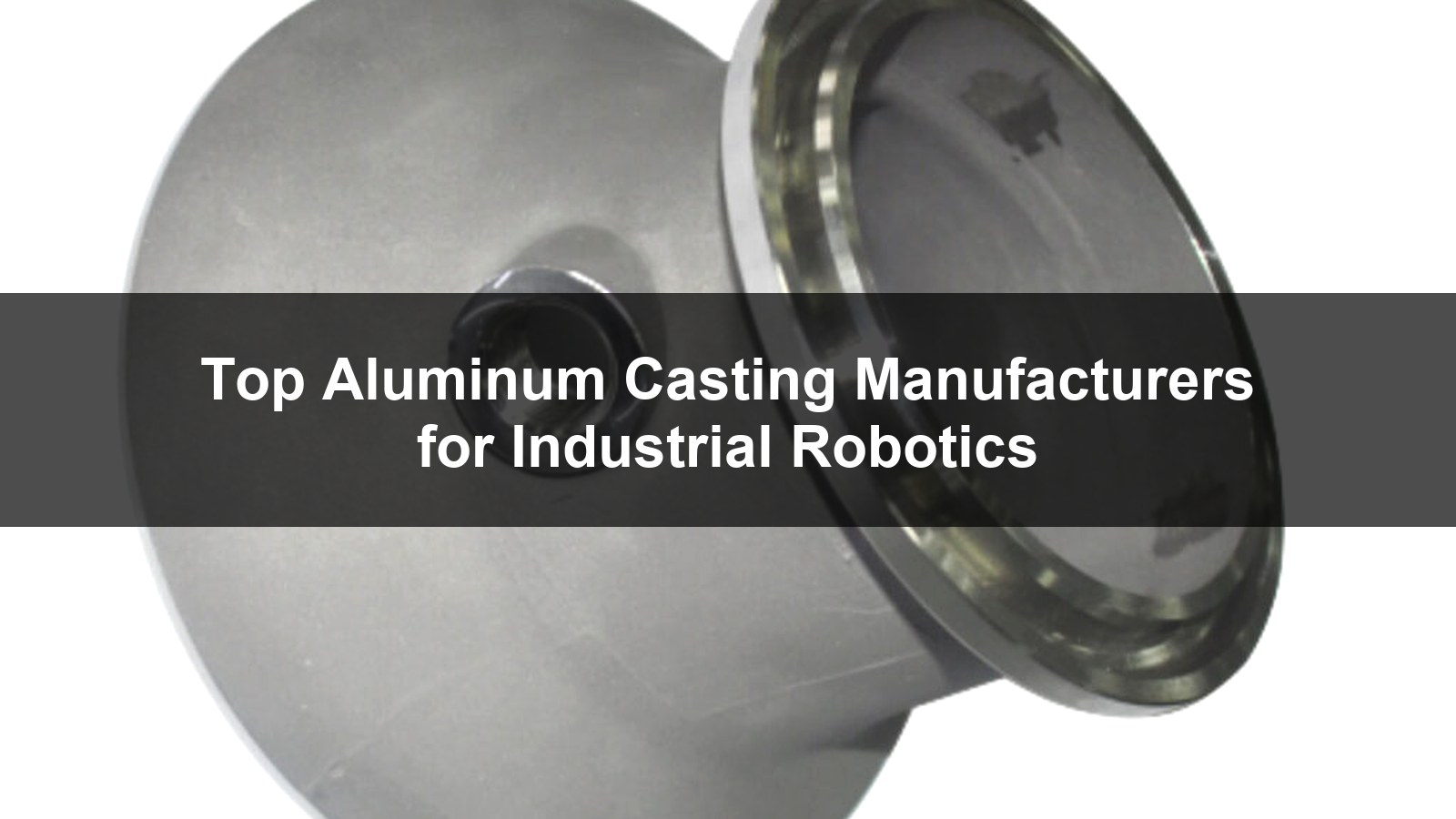
Are you looking for a reliable aluminum casting manufacturer for industrial robotics? Do you want to find a foundry that offers lightweight, high-stiffness structural parts and tight-tolerance machining for robot arms, joints and servo housings? Or are you hoping to work with a partner capable of handling low-pressure, gravity and high-pressure casting under one roof?
If the answer is yes, then the global market for aluminum casting manufacturers serving industrial robotics spans Asia, Europe and North America, with suppliers ranging from integrated foundries to specialized precision die casters. Below, we present leading aluminum casting manufacturers for industrial robotics to help you compare capabilities and shortlist the right partner for your robot components.
Quick Navigation
- Watry Industries
- Alucastor
- FUERD
- Grohmann Group (ALUWORKS)
- YCU Metal
- Sureton
- Yongzhu Casting
- Dynacast
- CZC Industry
- IHARA Manufacturing
1. Watry Industries
Website: https://watry.com/
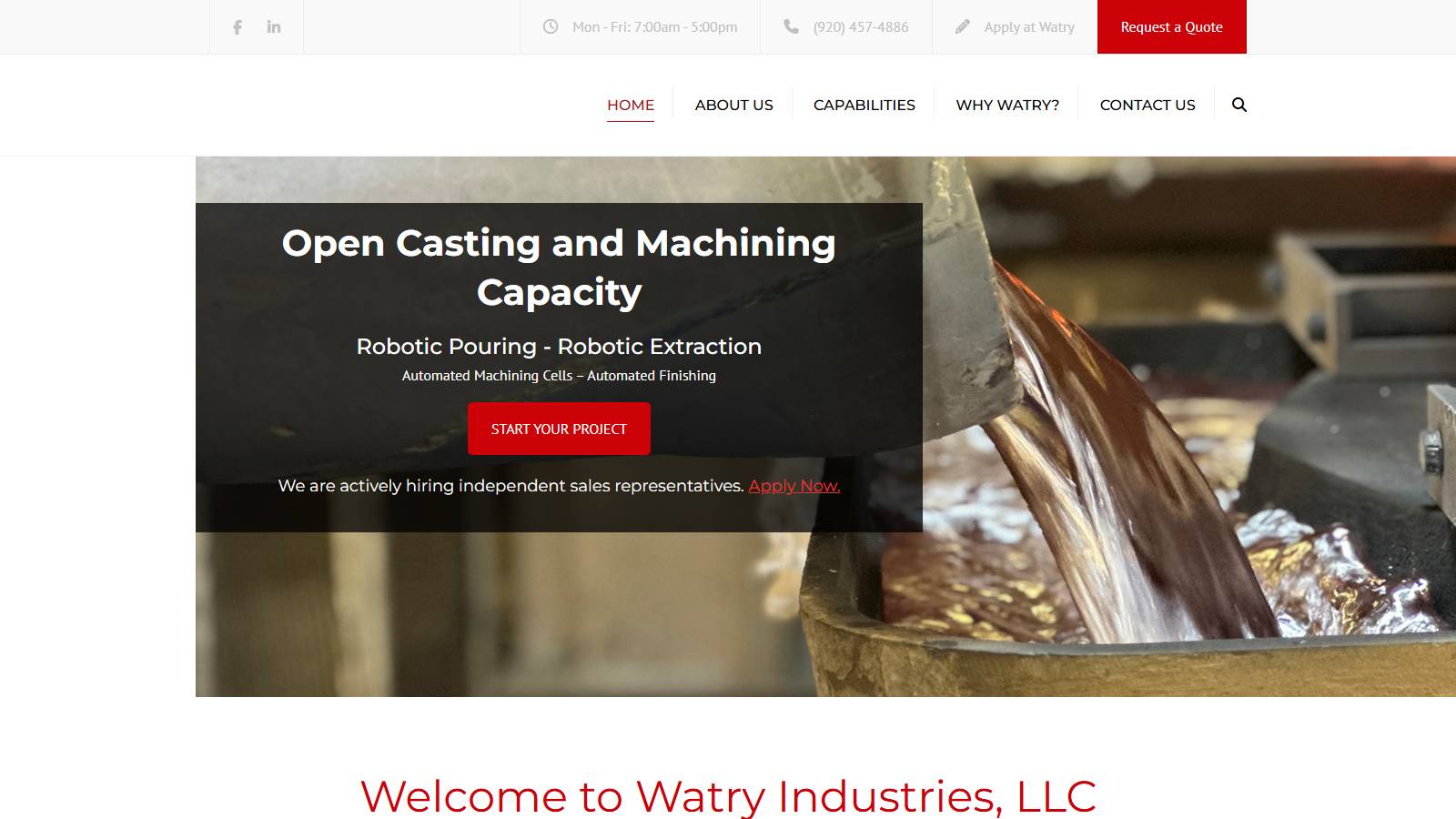
Headquarters / Supply Model: Sheboygan, Wisconsin, USA. Watry Industries has produced aluminum castings since 1957 and runs an integrated North American operation covering permanent mold, semi-permanent mold, traditional tilt-pour and reverse tilt-pour aluminum casting, with in-house CNC machining, finishing and testing.
Core Products / Technologies: Robotics and automation aluminum castings including robotic arm and joint housings, servo motor and actuator enclosures, end-of-arm tooling brackets, vision system housings and mounts, gearbox and drive housings, and control panel enclosures. Watry states annual output ranging from about 300 to 600,000 units, supported by in-house helium leak, pressure-decay, X-ray and vision inspection.
Why Consider Watry Industries: Keeping casting, machining, finishing and testing under one roof reduces interface risk and helps automation builders control dimensional consistency for seamless robotic alignment and motion control.
Best Suited For: North American robotics and automation OEMs that need lightweight, repeatable aluminum structural and enclosure parts with integrated inspection rather than fragmented suppliers.
Before Purchasing: Confirm the target alloy, part size and weight, annual volume, required inspection (X-ray, leak or pressure-decay), finishing (anodizing, powder coating) and lead time for your program.
2. Alucastor
Website: https://alucastor.com/
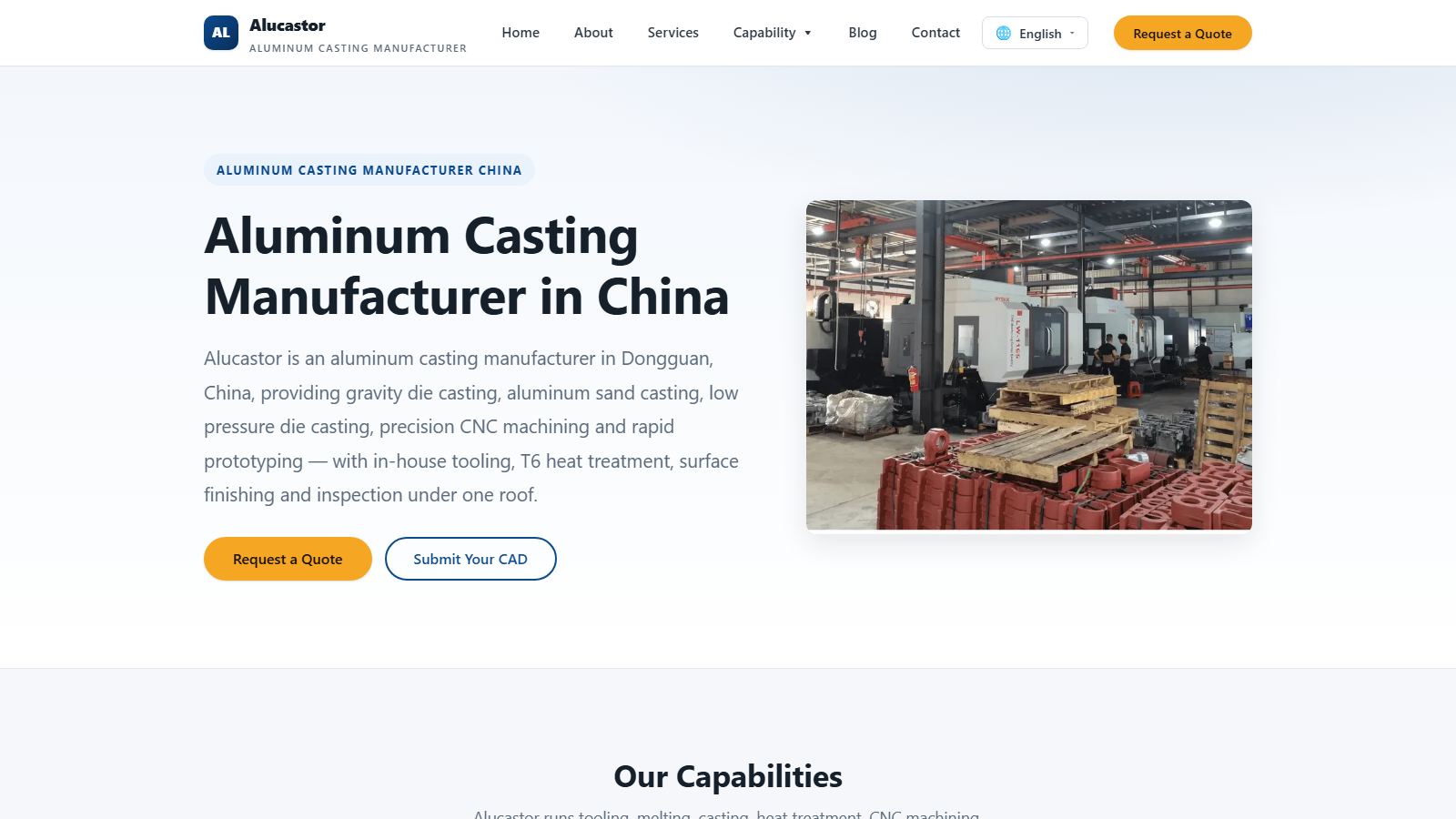
Headquarters / Supply Model: Qishi, Dongguan, China. Alucastor is an aluminum casting manufacturer offering gravity die casting, aluminum sand casting, low pressure die casting, precision CNC machining, rapid prototyping and OEM manufacturing, stating ISO 9001, IATF 16949, ISO 14001 and RoHS & REACH coverage.
Core Products / Technologies: Precision aluminum structural parts for robotics: robot links and joint housings, harmonic drive and gearbox mounting plates, end-effector and gripper bodies, AGV and AMR chassis components, linear axis carriages and brackets, and automation cell fixture plates. The company cites machined features to around ±0.005 mm and CMM-verified production.
Why Consider Alucastor: Its single-source casting, machining, finishing and inspection route lets larger links and housings be made near-net-shape and finished in the same plant, which supports low inertia and repeatable stiffness for faster, more accurate motion.
Best Suited For: Cobot, automation cell and equipment builders needing lightweight structural aluminum parts with tight tolerances and consolidated production.
Before Purchasing: Confirm the alloy grade (for example 6061 or 7075), achievable tolerance, casting route (gravity, sand or LPDC), volume and inspection documentation before committing.
3. FUERD
Website: https://www.fuerdcasting.com/
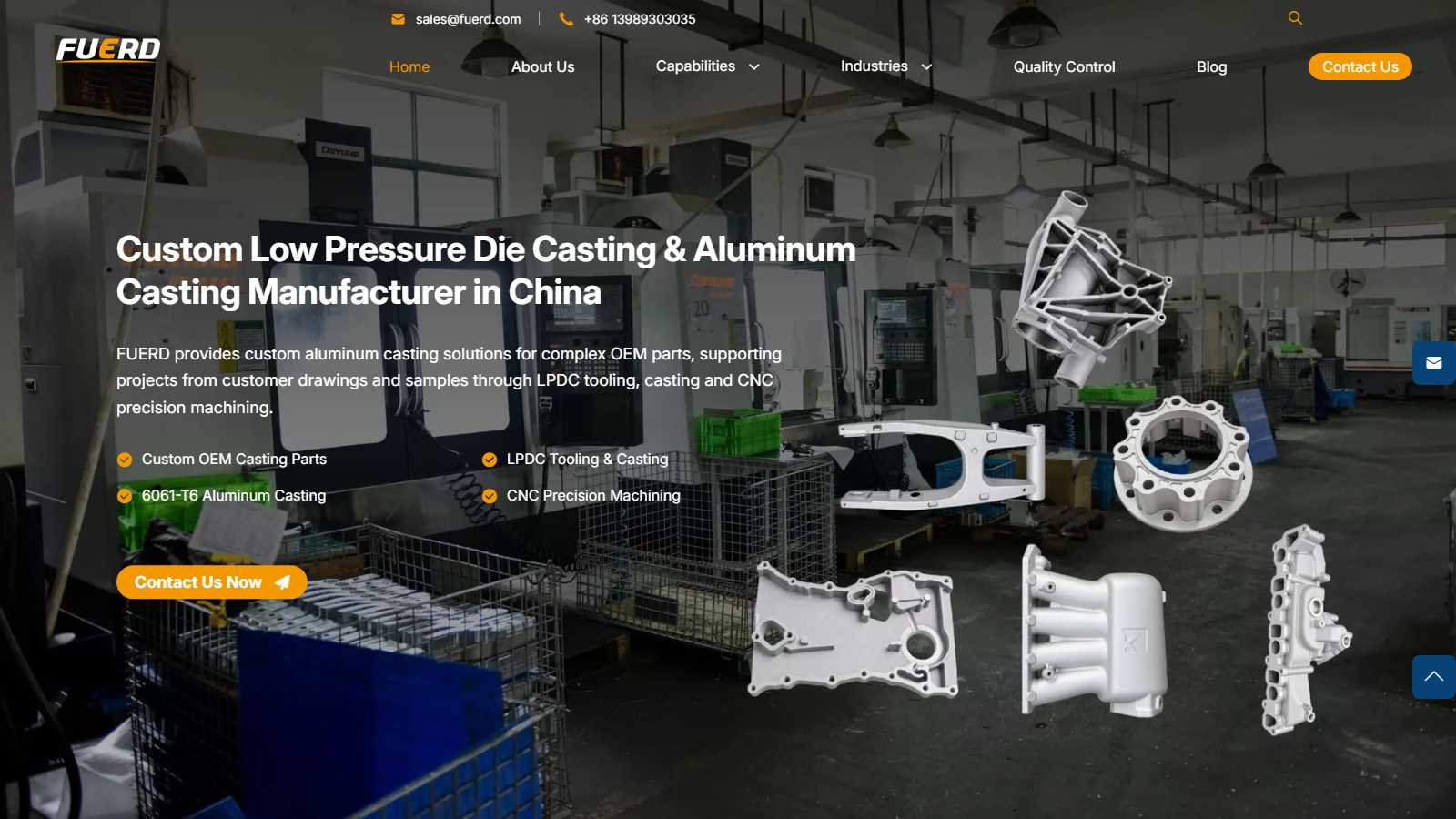
Headquarters / Supply Model: Ningbo, Zhejiang, China. FUERD (Ningbo FUERD Machinery) is a custom aluminum casting manufacturer founded in 2008 with in-house LPDC tooling development, integrating mold design, casting, CNC machining and finishing under one roof.
Core Products / Technologies: Custom low-pressure casting molds and serial aluminum parts; H13 steel, ductile iron and water-cooled mold options; side-slider and sand-core mold solutions; CAD/CAM/CAE full-process development. FUERD also provides LPDC, gravity casting, 6061-T6 semi-solid die casting (Rheocasting) and CNC precision machining, with casting capacity up to 200 kg, thin-wall capability down to 3.5 mm, 100% X-ray inspection and APQP/FMEA/PPAP control.
Why Consider FUERD: For industrial robotics, FUERD's relevant directions include robot arm housings, joint transmission housings, servo motor mounting bases, end-effector brackets and structural enclosures. Combining tooling and serial production in one workflow helps buyers move from drawings to stable mass production without coordinating separate mold and foundry shops.
Best Suited For: Robotics OEMs and engineering teams that need custom aluminum cast and machined structures for arms, joints, servo bases and end-effectors, and prefer a single accountable supplier for tooling and production.
Before Purchasing: Confirm the target alloy, mold material choice (H13, ductile iron or water-cooled), side-slider or sand-core requirements, T6 heat treatment and X-ray scope, and clarify MOQ and lead time for both the mold and the production parts.
4. Grohmann Group (ALUWORKS)
Website: https://grohmann-group.com/
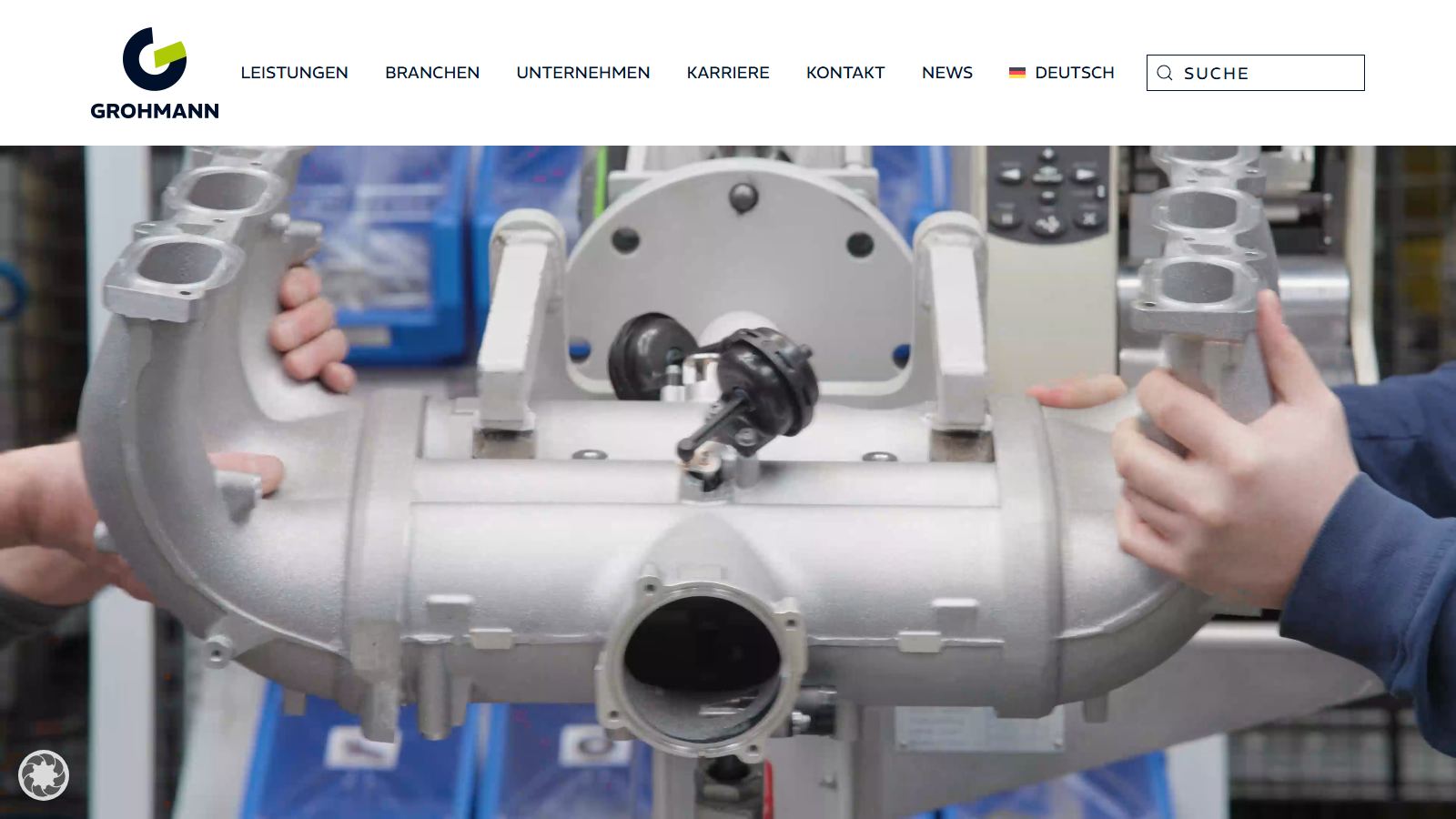
Headquarters / Supply Model: Germany-based group with German production locations, offering aluminum casting as a single-source partner from casting consultation through assembly-ready components.
Core Products / Technologies: Aluminum cast parts for robotics using sand casting, gravity die casting and castforging, supported by mechanical machining, surface treatment and assembly, with state-of-the-art 4- and 5-axis CNC machining and casting process simulation.
Why Consider Grohmann Group: Its combination of casting technology consulting, pattern and gravity die construction, and ready-to-install assembly helps reduce interfaces and development risk for dynamic robotics systems that demand precision, load capacity and longevity.
Best Suited For: European robotics and automation OEMs needing high-precision aluminum housings, joints and structural components with localized engineering support.
Before Purchasing: Confirm the casting process (sand, gravity or castforging), part size and alloy, required tolerances, surface treatment and whether assembly-ready delivery is included.
5. YCU Metal
Website: https://www.ycumetal.com/
Headquarters / Supply Model: Pingdu, Qingdao, China. YCU Metal operates a 34,000㎡ facility with IATF 16949 and ISO 9001 certification and 400+ staff, covering silica-sol investment casting, shell/resin sand casting, gravity and low-pressure aluminum casting, and in-house 3/4/5-axis CNC machining.
Core Products / Technologies: Robotic arm links and base pedestals, wrist joints and end-effector flanges, harmonic and RV reducer housings, and servo motor housings and controller covers, commonly in A356-T6. The company references in-house CT (Nikon XTH 320) and CMM verification for cast and machined features.
Why Consider YCU Metal: Consolidating raw casting, heat treatment and multi-axis finish machining under one quality system reduces datum-transfer stack-up between separate foundries and machine shops, which matters for cross-roller bearing seats and coaxial bores.
Best Suited For: Industrial articulated robot, AMR and gantry actuator programs needing gravity or low-pressure aluminum castings with tight post-casting CNC features.
Before Purchasing: Confirm the process (low-pressure, gravity or investment), alloy, required tolerances and concentricity, CT or X-ray inspection scope, and validation documentation format.
6. Sureton
Website: https://sureton.cn/
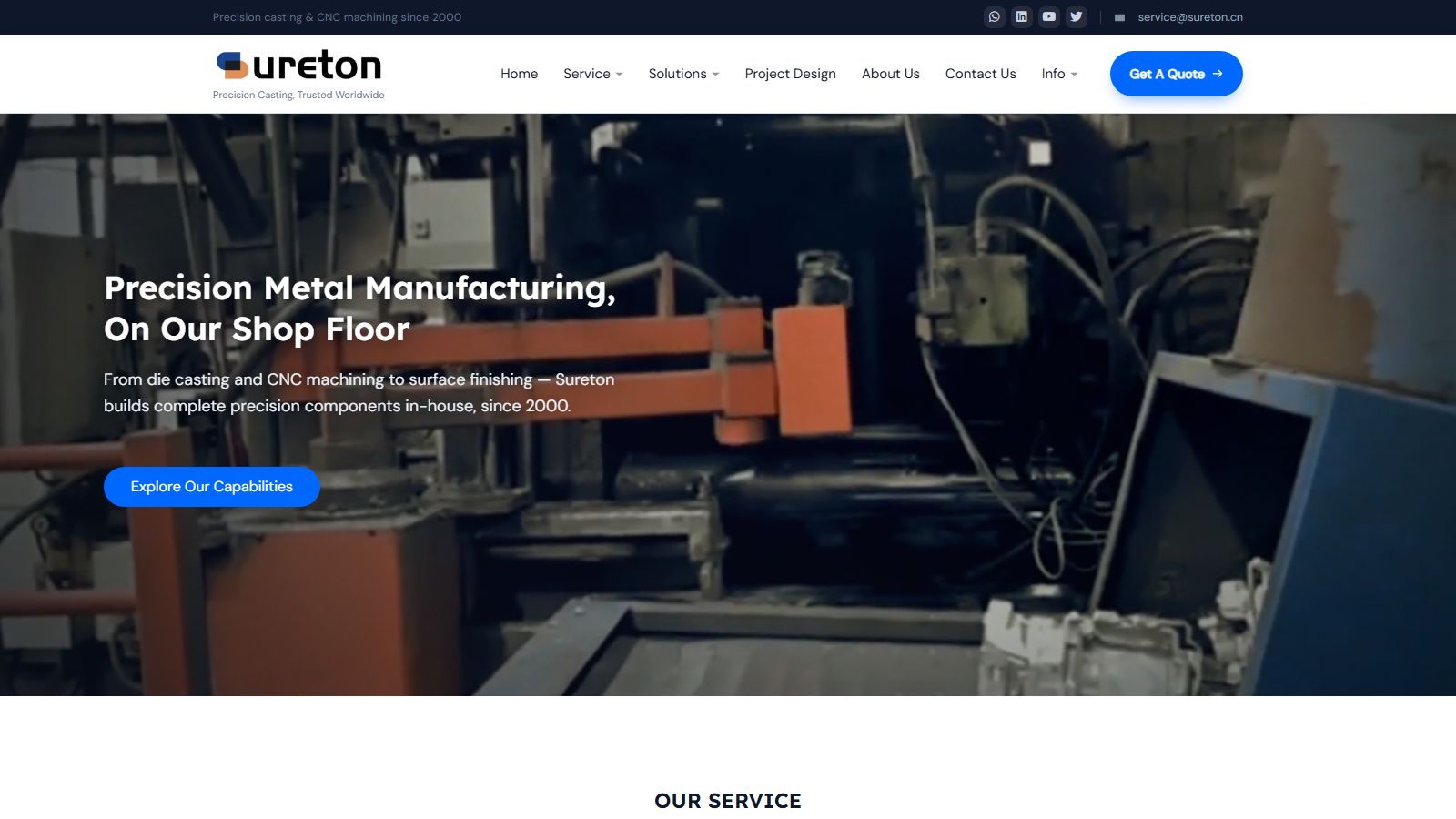
Headquarters / Supply Model: China-based die casting manufacturer stating ISO 9001:2015 and ISO 14001 certification, with 50+ CNC machines (3-, 4- and 5-axis), chemical pretreatment, surface treatment and quality inspection under one chain.
Core Products / Technologies: High-precision aluminum and zinc die casting for robotics and automation: actuators, gear housings, sensor mounts, structural frames, robotic arms, motor housings and control enclosures. Sureton cites in-house tooling, MAGMAsoft simulation and DFM analysis.
Why Consider Sureton: Its end-to-end route from part design and in-house mold making to die casting, CNC machining, surface finishing and final assembly suits robotics manufacturers that want co-design and rapid prototyping rather than fragmented suppliers.
Best Suited For: Robotics and automation brands needing lightweight, high-tolerance aluminum or zinc parts such as motor housings, actuator components and sensor hardware.
Before Purchasing: Confirm the alloy (aluminum or zinc), process (high-pressure die casting), tolerances, MAGMAsoft simulation reports and surface treatment, plus English engineering support for your region.
7. Yongzhu Casting
Website: https://casting-yz.com/
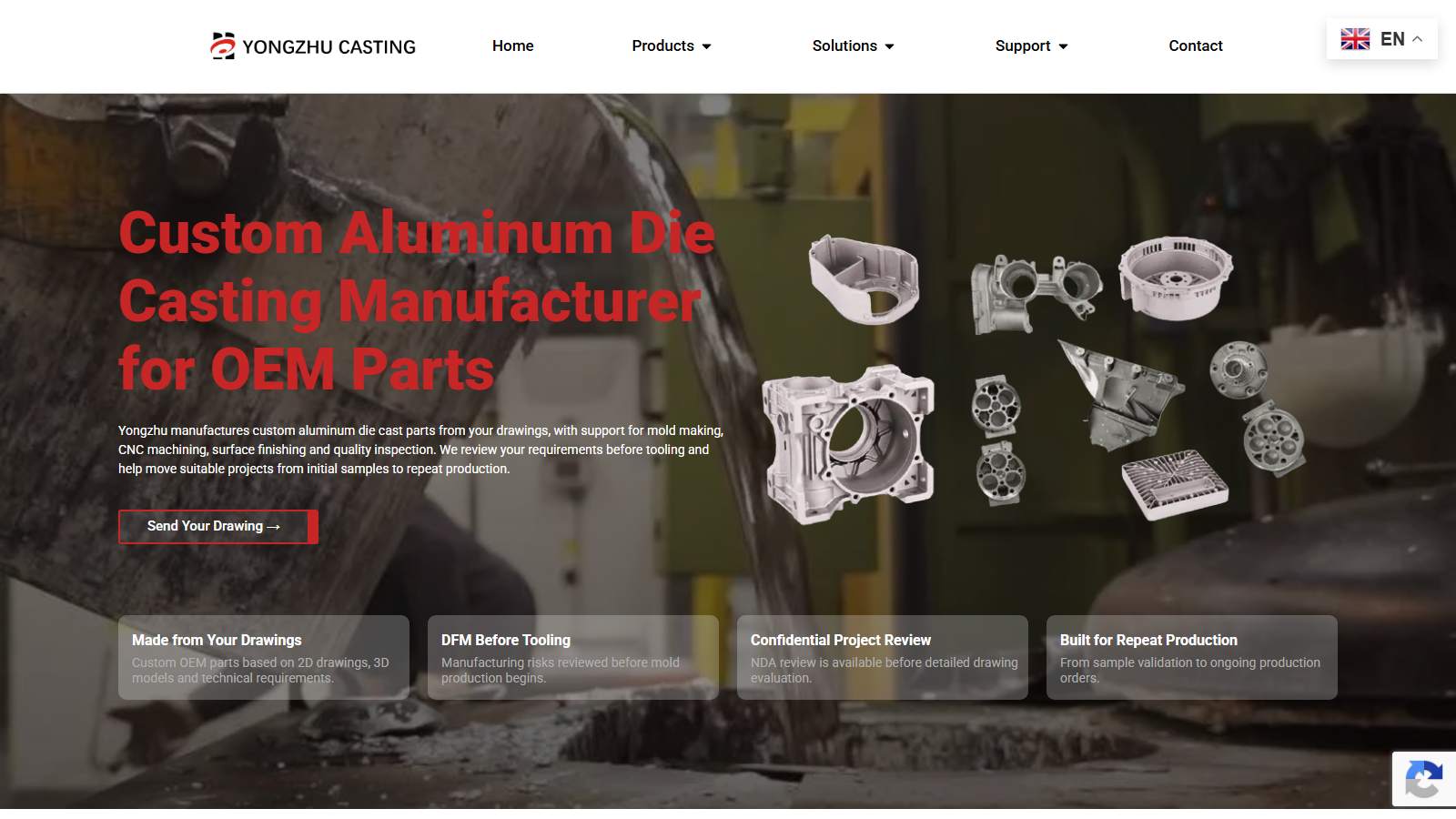
Headquarters / Supply Model: China-based custom aluminum die casting manufacturer supporting robotic equipment, automation systems and robot modules from design review through tooling, casting, CNC machining, finishing and inspection.
Core Products / Technologies: Robot aluminum die cast parts including joint housings, bearing seats, end covers and mounting interfaces; arm covers, connection parts, structural shells and end caps; motor housings, gearbox housings and transmission cases; plus bases, support brackets, mounting plates and sensor housings.
Why Consider Yongzhu Casting: Yongzhu reviews wall thickness, joint areas, mounting faces and machining allowance before tooling and can manage casting-to-finished parts in one project route, which shortens development for overseas buyers.
Best Suited For: Robot arm, cobot and automation equipment builders needing custom die cast housings, brackets, bases and motor/gearbox covers from drawings or samples.
Before Purchasing: Send 2D/3D drawings, target alloy, estimated annual volume, tolerances, surface finish and any special inspection needs, and confirm whether CNC machining of holes, threads and bearing seats is included.
8. Dynacast
Website: https://www.dynacast.com/
Headquarters / Supply Model: Global precision die casting manufacturer with multi-region production, focused on high-pressure die casting in aluminum and magnesium alloys for demanding, high-volume programs.
Core Products / Technologies: Precision die cast components for robotics including compact high-load joint nodes, bearing interface housings, multi-axis joint structures, actuator and gearbox housings, and structural links such as hip, knee and arm housings. Dynacast highlights part consolidation, thin-wall strength and integrated cooling fins cast into motor and actuator housings.
Why Consider Dynacast: Its high-pressure die casting process delivers tight tolerances for bearing alignment and repeatability with natural EMI/RFI shielding, and supports high-speed, repeatable production at global scale for programs moving from prototype to volume.
Best Suited For: Robotics companies ramping from low-volume prototypes to high-volume production of aluminum or magnesium structural housings and actuator/gearbox components.
Before Purchasing: Confirm the alloy (aluminum or magnesium), part-consolidation design, tolerances, volume ramp and whether near-net-shape casting or further assembly is required for your component.
9. CZC Industry
Website: https://czcindustry.com/
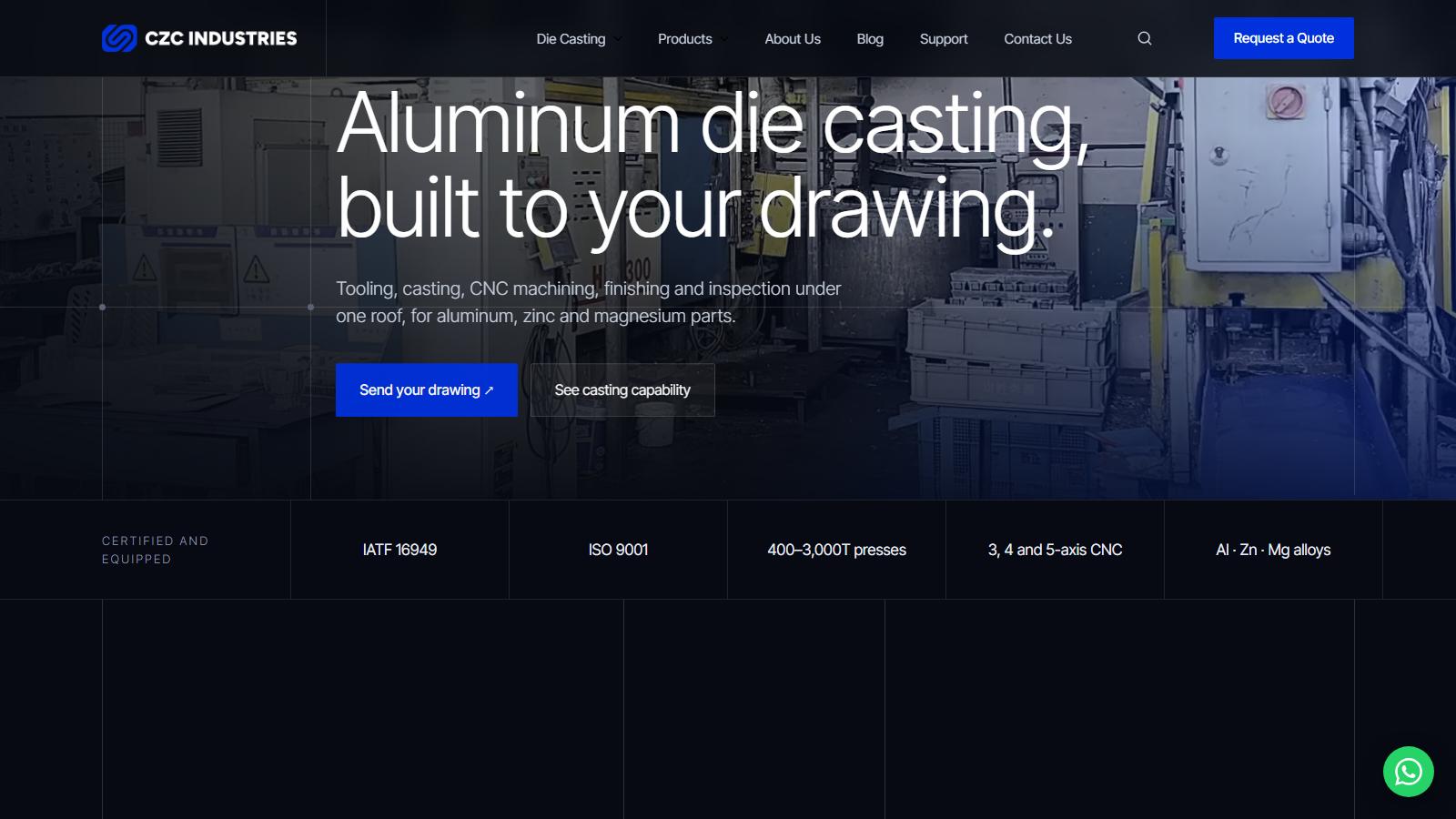
Headquarters / Supply Model: Custom aluminum die casting manufacturer and OEM supplier with in-house tooling and die casting, offering HPDC (hot and cold chamber), LPDC, gravity and vacuum die casting on machines from 400 to 3,000 T, citing tolerances around ±0.05 mm and wall thickness down to 0.8 mm.
Core Products / Technologies: Configurable die cast motor housings built around the stator bore, cooling requirement and mounting pattern. Categories include NEV drive motors, industrial servo, VFD-driven and spindle motor housings, plus appliance, power-tool, pump/fan and marine motor housings. Servo motor housings are described with tight bore and stop-face tolerances for consistent air gaps.
Why Consider CZC Industry: Because every motor carries different torque, heat and sealing needs, CZC opens tooling around the motor rather than offering fixed shells, which fits robotics actuators that need integrated cooling channels and thin, consistent walls.
Best Suited For: Buyers sourcing servo or industrial motor housings for robotics actuators, where bore/seal accuracy, cooling layout and mounting pattern must match a specific motor.
Before Purchasing: Confirm motor type, stator OD and cooling circuit (air-cooled fins or cast-in water/oil channels), bore and seal-face tolerances, alloy, surface finish and production volume.
10. IHARA Manufacturing
Website: http://www.iharamfg.co.jp/en
Headquarters / Supply Model: Hamamatsu, Japan, with additional bases in Thailand, Indonesia and Vietnam. IHARA manufactures aluminum die-cast parts, industrial robots and machine tools, providing an integrated system from casting to machining and assembly using in-house production equipment.
Core Products / Technologies: Aluminum die-cast products alongside custom-made industrial robots and machine tools. IHARA states it can support customers from upstream development to mass production, combining aluminum die casting with machining and assembly under one operation.
Why Consider IHARA Manufacturing: For buyers who want both aluminum die-cast components and robotics capability from one Japanese-headquartered supplier, IHARA's integrated casting-to-assembly route and multi-country bases help balance cost competitiveness with reliable quality.
Best Suited For: Japanese and Asia-based automation buyers needing aluminum die-cast parts and/or custom industrial robots, with regional production across Thailand, Indonesia and Vietnam.
Before Purchasing: Clarify whether you need a die-cast part, a custom robot system or both, the alloy and volume, which production base applies, and available English-language engineering support.
Key Factors That Affect Your Price
Aluminum casting prices for robotics components are driven less by a single number and more by engineering scope, so buyers should evaluate the following factors before comparing quotes, because two "robot housings" can differ sharply in what is actually included.
- Casting process: Low-pressure, gravity, sand and high-pressure die casting each carry different tooling and per-part economics; HPDC favors high volume, while LPDC and gravity often suit thicker, sounder structural parts.
- Alloy and heat treatment: A356-T6 or A357 offer heat-treatable strength for structural links, while ADC12 or A380 suit thin-wall, non-heat-treated enclosures. Alloy and T6 treatment change both cost and performance.
- Part size, wall thickness and complexity: Larger castings, thin walls down to 3.5–0.8 mm, side sliders, sand cores and multi-cavity layouts increase machining time and material, raising the price.
- Machining and tolerances: Bearing bores, mounting faces and coaxiality held to ±0.005–0.05 mm require 4-/5-axis CNC and inspection, which add cost versus as-cast surfaces.
- Inspection and documentation: 100% X-ray, CT, helium leak or pressure-decay testing and PPAP/APQP packages add overhead, mostly for automotive-grade or safety-critical robotics parts.
- Logistics and finishing: Anodizing, powder coating, export packing, spare tooling and regional support affect total cost beyond the initial part price.
FAQs – Aluminum Casting for Industrial Robotics
1. Which casting process is best for robot arm and joint housings?
Low-pressure or gravity casting in A356-T6 often suits structural links and joints needing elongation and soundness, while high-pressure die casting fits high-volume thin-wall enclosures. The right choice depends on load, volume and heat treatment needs.
2. What aluminum alloy should I specify for robotics castings?
A356-T6 or A357 give heat-treatable strength for structural parts, whereas ADC12 or A380 provide thin-wall repeatability for covers and housings. Confirm the alloy with the foundry based on your stiffness and finishing requirements.
3. How tight can machining tolerances be on cast robot parts?
Representative suppliers cite machined features from about ±0.005 mm to ±0.05 mm depending on process and equipment. Share your bearing-seat and mounting-face tolerances so the supplier can confirm feasibility.
4. Do these manufacturers provide X-ray or CT inspection?
Several listed suppliers offer 100% X-ray, CT or leak testing, which helps verify internal soundness for joints and servo housings. Confirm whether inspection is included in the quoted scope and what reports are provided.
5. What should I send when requesting a quote for robot castings?
Send 3D drawings, target alloy, part weight and wall thickness, annual volume, required tolerances, surface finish, casting process preference and delivery location so suppliers can return a comparable quote.
6. Can servo motor housings be die cast for robotics actuators?
Yes. Custom die cast servo and industrial motor housings are offered with tight bore and seal-face tolerances and configurable cooling channels. Provide the motor's stator OD, cooling need and mounting pattern for an accurate tooling plan.
Who Is the Best Aluminum Casting Manufacturer for Industrial Robotics?
There is no single best supplier for every robotics program. The right choice depends on your part geometry, alloy, volume, inspection needs and regional support requirements, so the shortlist above is best used as a starting point for comparison.
FUERD is a strong option for buyers who want custom aluminum cast and machined robotics structures from one supplier, including robot arm housings, joint transmission housings, servo motor mounting bases, end-effector brackets and structural enclosures, backed by in-house LPDC tooling, 6061-T6 semi-solid (Rheocasting) capability and 100% X-ray inspection under APQP/FMEA/PPAP control.
To discuss a project with FUERD, provide your 3D drawings, target alloy (such as A356-T6 or A357), part weight and wall thickness, casting process preference, required tolerances and inspection scope, annual volume and delivery location.
Notice: Ensure your image is no larger than 2MB before uploading.